

Subscribe to our newsletter
Enter your email address below and subscribe to our newsletter
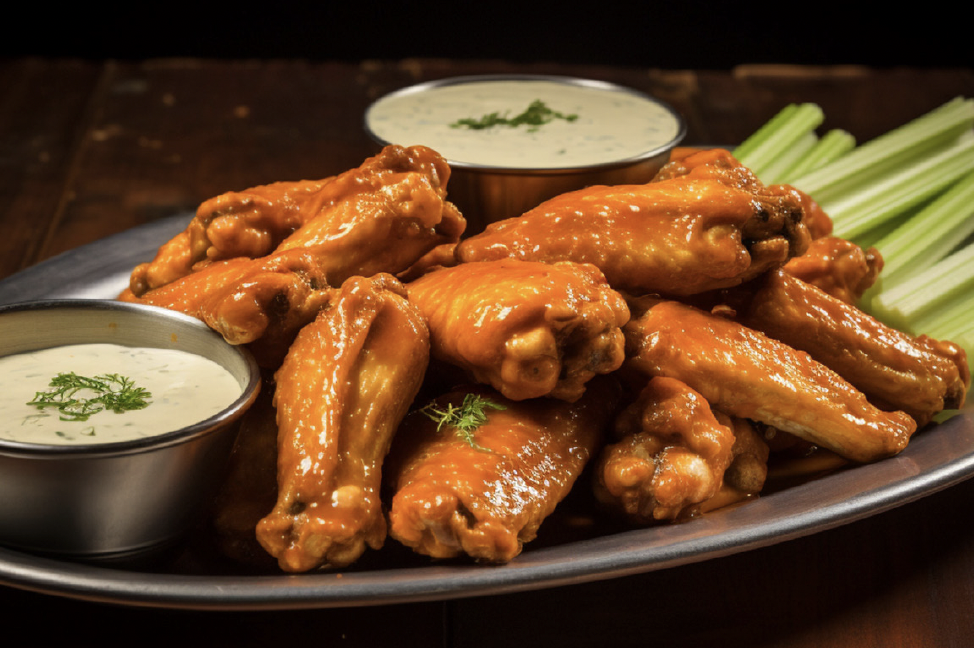
I recently watched a segment of The History Channel’s Food That Built America series, “Flight of the Buffalo Wing,” in anticipation of Super Bowl LX (60th). During the piece I found myself questioning facts and timelines, which sparked my deep dive into the true origin of the popular buffalo wing.
The two major players are the Bellissimo family of the Anchor Bar and John Young of Young’s Wings and Things. There is also a piece of tangible history shown in the form of an 1857 bill of fare from the Clarendon Hotel located at Main and South Division Streets in Buffalo, listing an entree option of “Chicken Wings, Fried.”
Fanfare aside, the Anchor Bar in Buffalo, NY, has been generally recognized as ground zero for buffalo wing creation in 1964, with some slight timeline variations. A few stories have circulated as to the exact circumstances behind the accidental creation, but the standard version goes a little like this: Co-owner Teressa Bellissimo cooked wings that were delivered to the restaurant in error late one evening as a snack for her son and his friends, tossing them in a hot sauce before serving. The story continues that the wings were so enjoyed that they became a standard menu item the next day with the addition of celery sticks and blue cheese dressing. Teressa is noted for chopping the wings in half, resulting in drums and flats, thus creating today’s standard finger-food version.
Meanwhile, less than a mile away, and arguably a couple of years earlier, at “Young’s Wings and Things,” the proprietor John Young spoke with a traveling boxer who told him of a Washington, DC, area restaurant (Wings ’n Things) that was “doing great things with wings.” John then created a mumbo sauce for the wings, sometimes referred to as mambo (a barbecue-style sauce with tropical fruit). And so began John’s foray into creating a world where buffalo wings prevail. John has publicly voiced that wings were a common dish growing up and that he routinely served them in his establishment long before The Anchor Bar created their famed buffalo wing. John’s wings were served whole, breaded, deep-fried, and sauced. The Anchor Bar’s version was cut into sections, deep fried, sauced, and served with celery and blue cheese dressing.
John Mack Young was born in Stockton, AL, in 1934 and worked with his father in the kitchen on a riverboat as a young lad, before the family relocated to Buffalo, NY, during the Great Migration (with hopes of avoiding further discrimination) that led many Black men and their families northward. It was during the Great Migration that the term “soul food” became popular vernacular, associating deeply rooted traditional southern foodways with the Black families that fled to the areas of New York, Chicago, and Detroit. During John’s early years spent in Lower Alabama, just north of the Bay Area of Mobile, his palate developed within the region’s medley of influences from African, French, British, Spanish, and Native American origins.
In the mid-1960s, after the NY riots that destroyed numerous Black-owned businesses, Young moved to Illinois for a few years, where he ran food trucks. Young later returned to Buffalo amidst the rise of the popular term “soul food.” Soul food generally encompasses the foodways of the African communities of the American South, notably the subregion of the “Deep South” (which primarily includes Louisiana, Mississippi, Alabama, Georgia, and South Carolina.) This distinct subregion is known for its slavery-laden plantation agriculture along the Cotton Belt.
Food historians can trace consumption of the common chicken wing to the early years of the American subregion of the Deep South, which tracks, given the foodways of the African culture in the area, much like the food influence of the Gullah-Geechee community of America’s Lowcountry region, where cheap, local ingredients reigned superior.
The explosion of the buffalo wing hitting menus across the nation is credited in part to the addition of buffalo sauce (or mumbo sauce from John Young) and the accompaniments of celery stalks and blue cheese from Teressa Bellissimo.
John Young’s daughter, Lina Brown-Young, is busy preserving her father’s role in history by offering retail bottles of his famous sauce. Lina sells the original sauce and a spicy version. The sauces can be purchased at retailers throughout western NY and directly from johnnyyoungsoriginal.com.
Let’s give it up to the unknown chef of the Clarendon Hotel for adding chicken wings to the menu as an entree; the DC area Black-owned restaurateur who purportedly did “great things with wings”; John Young, who presented the wing drenched in mumbo sauce to area Buffalonians; the Bellissimos of The Anchor Bar, who cut the wing in half, skipped the breading, and added celery and blue; and the chain restaurants that propelled popularity beyond expectations—TGI Fridays, Hooters, and Buffalo Wild Wings. In concert, these proprietors and establishments all played an integral part in the transformation of the lowly “soup bone wing” into the nation’s most popular game day snack it has become.
Today’s food scene has just about every iteration one could imagine for wings. Whether served “naked” or tossed in any sauce imaginable, extra crispy, grilled, dry, and so on, one thing is for sure — wings are here to stay, and loyal fans will continue to reinvent the classic.
Here in the Lowcountry of SC, I make a coastal version that I call “Swim and Fly.”
Brine wing sections overnight in clam juice, rinse and pat dry, deep fry the wings (without breading), and toss in lemon juice and melted butter, and add a nice dusting of Old Bay® seasoning. Serve half and half with Calabash-style (lightly breaded and deep-fried) local shrimp, Frank’s RedHot® Wings sauce, extra spicy horseradish cocktail sauce, blue cheese dressing, and celery/carrots on the side.