Subscribe to our newsletter
Enter your email address below and subscribe to our newsletter

Enter your email address below and subscribe to our newsletter
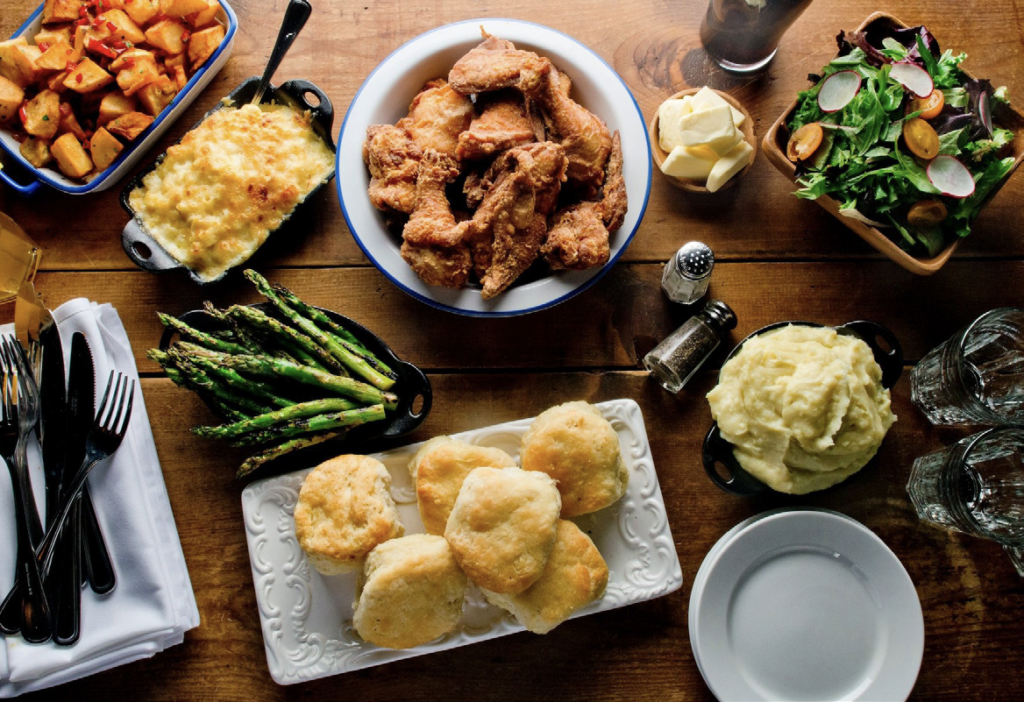
It’s often the first words you’ll hear as you step inside your grandmother’s home. “Are you hungry?” Ah, the memories of being fed delicious goodies straight from the oven. It’s like there’s a magic fairy in the ears of grandmothers everywhere, whispering that a grandchild is about to pop over for a visit.
I could barely reach the top of the counter, so Granny pulled over a stool. I watched her cut shortening into the flour, and then she waited for me to pour buttermilk into the bowl.
“Just enough, you can add more if you need to,” she carefully instructed.
I was around six years old. I was so excited to help in the kitchen and gobbled up all the information she shared. My sweet granny made an enormous family dinner on most Sundays, and it always included homemade buttermilk biscuits. She had ten children, and those children had children… yes, our family was large. She never invited anyone to Sunday dinner (served midday); people simply arrived. Sometimes there would be ten or fifteen; sometimes there would be twenty or so. It’s not like her children had a calendar and rotated visits; it just happened, and somehow there was always enough food to go around. I cherished cooking with her and the lessons learned. Even the simple things she shared remain with me. Did you know you can add a raw potato to a pot of soup to absorb excess salt? Yes, those sorts of tips. She taught me to tear (not cut) fresh greens and give them a good bath in a sink full of water. She taught me that the potlikker “pot liquor” was best achieved by simmering the greens low and slow with a ham hock and seasonings. She taught me to make savory southern succotash, how to fry delicate, fresh okra in only a light dusting of cornmeal, and how to create the best black-eyed peas with rich, umami “juice” (like the potlikker from greens). It’s a savory, nutrient-rich, concentrated broth. Those Sunday mornings on a stool in her kitchen were priceless.
I’ve learned over the years that there are a few things more important than the recipe. First, you must enjoy the process; the number one ingredient is love. When others consume food that is cooked with the intention of love, it not only tastes better, but it is energetically healthier.
All things in this world are made of energy, and we all know that “energy can neither be created nor destroyed, but only transferred,” a quote most commonly attributed to Albert Einstein, but also known as the general consensus among several scientists in the 1840s, and adopted as ‘The Law of Conservation of Energy’ and the ‘First Law of Thermodynamics.’ Thus, when you’re preparing food, be happy, be positive, and transfer warm energy into the food… Infuse the food you prepare with love.
Second, you need to rely on your instincts; cooking intuitively is something that is learned through trial and error—and I believe it’s the best way to have fun in the kitchen. Relax, don’t be afraid to try new things, and every now and then simply use a recipe as a foundation, adding your own ideas as you go.
I develop recipes. I enjoy doing it—tracking measurements, tweaking throughout the process, and finalizing the perfect ratio of ingredients for others to use; hopefully with the same results as my test kitchen. However, when I am not creating recipes, I don’t measure and often don’t even taste—it’s intuition, it’s decades of practice, it’s letting the art of cooking express itself onto the plate. Cooking and entertaining should be an enjoyable task.
My paternal granny taught me patience and persistence in her Virginia farmhouse kitchen. She let me help and experiment, even when she knew the dish would be less than perfect, sometimes even inedible. She taught me to learn through experience and how to trust my instincts—that eventually developed because of the free rein that she offered during the years I learned my way around the kitchen.
I learned different things from my maternal grandma. I would often spend at least one weekend a month with her from age six to sixteen; then I was too involved with being a teenager. I look back fondly, remembering our time together. We went on road trips together, visiting restaurants along the way, and singing loudly in the car with the windows down. Our trips were centered around visiting relatives that lived a few hours away in various directions; we often spent the night or multiple nights with them, and we never arrived empty-handed. We would decide what to bring during our drive. Sometimes we’d pick up take-out or stop at the market for supplies to prepare a feast that evening.
When we stayed home, she allowed me to take over her small galley of a kitchen and whip up anything I could imagine. She liked to cook but loved baking more. There was always a cake on the counter. She had tons of spiral-bound church cookbooks with hand-written notes in the margins of changes she made over time. She taught me to be bold in the kitchen, to let my creativity shine, and to eliminate fear. She taught me that a recipe is nothing more than a suggestion. She told me the best dishes come from the heart; something she had in common with my paternal granny. She went beyond the basics of Southern Appalachian staples and loved making unique things that were unknown to me at the time. She freely used spices and seasonings and introduced me to different proteins and vegetables. As she aged, she cooked less frequently and developed tricks we now refer to as short-cut cooking methods. She traded in her baking apron for a boxed cake mix that she would enhance: a dry box of pudding for a moist result; extra autumn spices, freshly grated carrots, and praline pecans were added to a spice cake mix; and for a yellow boxed cake mix, she would add drained mandarin oranges, flaked coconut, and extracts of butter, vanilla, and orange. She could turn a graham cracker crust into gold by adding crushed pecans and brown sugar as another layer before a filling of cheesecake. She would add a frozen pack of strawberries to a blender with a block of cream cheese, a dash of lemon and vanilla extracts, and a tub of Cool Whip—all of which she piled high into a delectable crust of crushed shortbread cookies, butter, and dark brown sugar. This was her “freezer” summer strawberry pie, and it was divine. She made “potato cakes” of nothing more than leftover whipped potatoes, flour, scallions, and a little salt and pepper.
My maternal grandmother and paternal granny were different in many ways. They each taught me more than they realize, or perhaps that was the plan all along; more than cooking, more than tips and tricks in the kitchen—they taught me about life and living, they offered different points of view, they shared their religious beliefs through stories, they showed me different paths, and they led me to believe that I could be, do, and have anything I desired.
I learned my way around the kitchen long before I pursued professional culinary training. In fact, it was my grandmothers who laid the foundation. I am grateful for the knowledge they passed along, handed down to them from their grandmothers, and I can’t wait until my granddaughter is sitting on a stool at the counter with me, eagerly waiting to pour in the buttermilk.